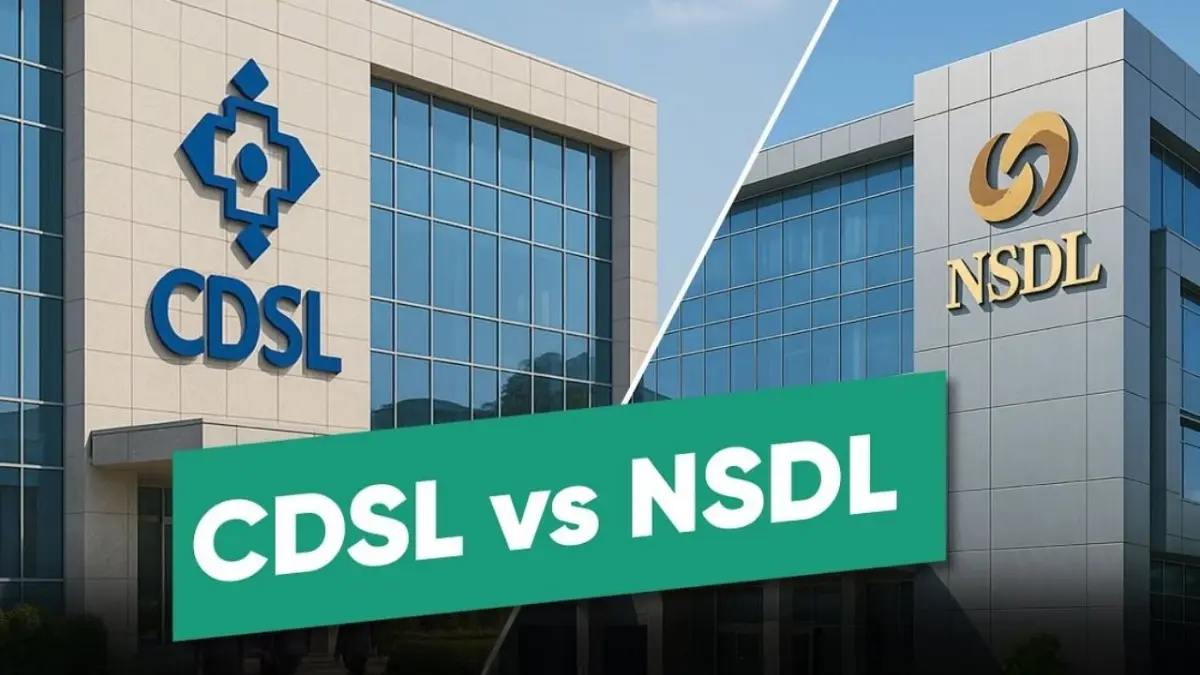
CDSL vs NSDL: India’s depository market is primarily controlled by two large institutions—National Securities Depository Limited (NSDL) and Central Depository Services (India) Limited (CDSL). Both companies offer electronic storage and transfer of securities, but their business models and investor bases differ significantly. NSDL primarily serves institutional clients and focuses on high-value accounts, mutual funds, and government projects. CDSL, on the other hand, is popular with retail investors and has an edge in account numbers, benefiting from fintech-based retail participation.
Indices and Price Performance
National Securities Depository Limited has a market capitalization of ₹22,730 crore and a share price of approximately ₹1,136.50 per share. The stock was listed on the BSE and NSE in August 2025 and has gained 21% since then. On the other hand, Central Depository Services (India) Limited has a market capitalization of ₹33,649 crore and a share price of approximately ₹1,610 per share. The stock was listed on the NSE in 2017 and has gained approximately 559% in the past five years, while it has seen a growth of 4% in the past one year.

Q2 FY26 Results
NSDL reported stable year-on-year growth in Q2 FY26. Revenue increased by approximately 12% to ₹400 crore. EBITDA increased by 12.4% to ₹127 crore, and net profit increased by approximately 14.3% to ₹110 crore. Earnings per share (EPS) also increased by approximately 14.8% to ₹5.52, reflecting the company’s stable profitability. On a quarterly basis, revenue grew by 28.2% and EBITDA by 34%, while net profit increased by 22.8%.
In contrast, CDSL’s Q2 FY26 results were slightly weaker than the prior year. Revenue declined by approximately 0.9% to ₹319 crore. EBITDA declined by 12% to ₹176 crore, and net profit declined by 13.6% to ₹140 crore. EPS also declined by approximately 13.4%. However, on a quarterly basis, the company has made a strong comeback, with revenue increasing by 23.2%, EBITDA by 35.4%, net profit by 37.3%, and EPS by 36.7%.
Investor Base and Asset Management
As of FY2025, NSDL added 3.68 million new investors, with demat-listed securities valued at ₹464 trillion. It also has 1.047 million accounts from non-resident and other categories of investors, reflecting its institutional dominance. CDSL, meanwhile, added 3.738 million new investors during the same period, demonstrating its retail orientation and rapid account growth. CDSL holds securities worth ₹71 trillion, and its non-resident investor accounts are lower than NSDL’s.
Dividends and Brokerage Opinion
NSDL declared its first dividend of ₹2 per share in the second quarter of FY26. Additionally, NSDL distributed ₹18.3 crore as dividend to its subsidiary, NDML. CDSL, on the other hand, paid a dividend of ₹12.50 per share in this quarter, four times higher than NSDL’s.

Brokerage firm ICICI Securities has assigned a “hold” rating to NSDL and a target price of ₹1,170, noting its strong capital-light model and recurring revenue share. Motilal Oswal has assigned a “neutral” rating to NSDL with a target price of ₹1,270, expecting steady growth over the next three years. ICICI has upgraded CDSL to “hold” and has a target price of ₹1,500, while Motilal Oswal has assigned a target price of ₹1,520, slightly below the current price.
Final Words
Both National Securities Depository Limited (NSDL) and Central Depository Services (India) Limited (CDSL) play a significant role in India’s depository sector. NSDL controls more institutional and large-value accounts, while CDSL has a greater presence among retail investors and fast-growing accounts. Both companies, with their distinct strengths, have strong future growth potential. Investors should monitor their financial performance, dividend policies, and market trends.
Disclaimer
This article is presented for informational purposes only and should not be considered investment advice. Consulting your financial advisor before investing is recommended. The information provided in this material is based on reliable sources, but its completeness and accuracy are not guaranteed.